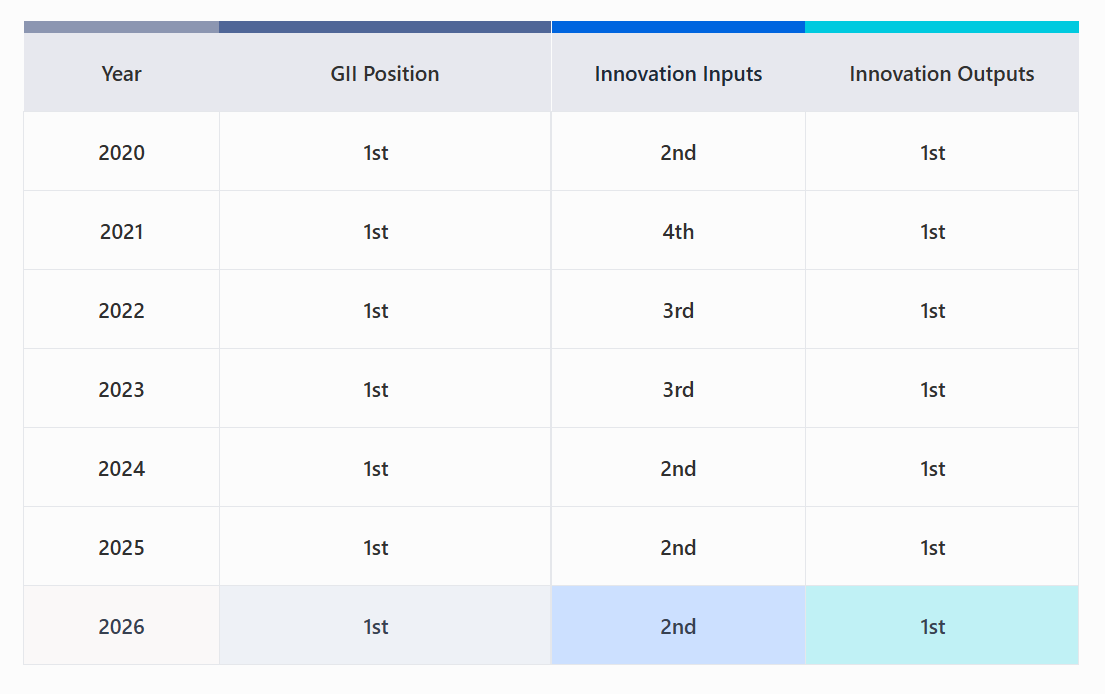
Switzerland has ranked first in WIPO’s Global Innovation Index for the seventh consecutive time. The 2026 edition covers 139 economies and is published by the UN agency in Geneva.
Switzerland scored 66.7, ahead of Sweden at 63.2 and the United States at 62.3. South Korea (61.4) and Singapore (61.0) completed the top five.
The leading group changed little from last year. The UK is sixth, followed by the Netherlands (7th) and Finland (8th), which traded places. Denmark (9th) and China (10th) held their positions. Germany is 11th and France 13th as of 2025, while Austria (18th) and Ireland (19th) swapped places.
Switzerland ranks 1st among the 54 High-income group economies.
Europe holds 14 of the top 25 places, including six of the top ten. China is the only upper-middle-income economy in the top 30. It ranks fifth for innovation outputs but 22nd for inputs, meaning it gets more results than its spending and conditions would suggest. The UAE has entered the top 25.
Switzerland ranks 1st among the 39 economies in Europe.
The index uses about 80 indicators, including R&D spending, venture capital deals, high-tech exports, and patent applications. It evaluates five input pillars: institutions, human capital and research, infrastructure, market sophistication, and business sophistication. It also assesses two output pillars: knowledge and technology outputs, and creative outputs.
Where Switzerland Improved And Where It Slipped
Switzerland improved on seven indicators over the last two years and deteriorated on three.
-
Scientific publications rose 0.8% since 2024.
-
R&D investment was up 1.3% since 2023.
-
Productivity grew 1.8%.
-
Fixed broadband coverage improved 1%.
-
Life expectancy rose 0.3%.
-
Robotics grew 5.9% since 2023.
-
Electric vehicles grew 25% since 2024.
On the negative side, patent applications fell 6.2% year on year. The number of investment rounds dropped 19.1%, the sharpest decline of the three weaker indicators.
Swedish King Visits Zurich’s Innovation Sector
Sweden’s King Carl XVI Gustaf visited the canton of Zurich on Monday, 5 October 2026. The visit was part of the 28th Royal Technology Mission of the Royal Swedish Academy of Engineering Sciences (IVA), organised at the king’s initiative.
The delegation was led by IVA chairman Marcus Wallenberg and IVA president Prof. Sylvia Schwaag Serger. The canton said the focus was on deepening ties in innovation, competitiveness and industrial transformation.
The group first toured the Switzerland Innovation Park Zurich, where it was received by Zurich’s Government President and Economic Affairs Director Carmen Walker Späh and Christof Domeisen, chairman of IPZ Operation AG. Stops included the ETH Hangar, the deep-tech companies Embotech and Stellar Alpina, and student technology projects Swissloop, ARIS, Cellsius and aCentauri.
The delegation then visited other Zurich companies and ETH Zurich. The day ended with a banquet at the Zunfthaus zur Meisen, which Walker Späh hosted. She said the visit was marked by “great mutual interest and deep appreciation,” and called it an honour for the canton to host the Swedish royal family.
A Global Funding Picture
Worldwide investment in innovative start-ups rose 28% to USD 510 billion in 2025, the strongest growth since 2021. The number of venture-capital deals fell, but funding spread more widely across regions. African start-ups raised USD 3.2 billion, up 40%.
North America captured 86% of global AI-related venture capital value in the first half of 2026.
WIPO says Europe’s main challenge is turning research and industrial strengths into fast-growing firms, scale-up financing and productivity growth. Gulf economies such as the UAE, Saudi Arabia, Qatar and Kuwait have strong inputs but still need to convert them into knowledge and creative outputs more effectively.
For Switzerland, the fall in investment rounds and patent applications is a reminder that a top ranking doesn’t guarantee continued momentum. The index suggests leadership increasingly depends on how effectively countries convert research, talent and investment into results.
Read More: Zurich’s “Stable” Jobless Rate Masks A 9.1% Rise In Unemployment