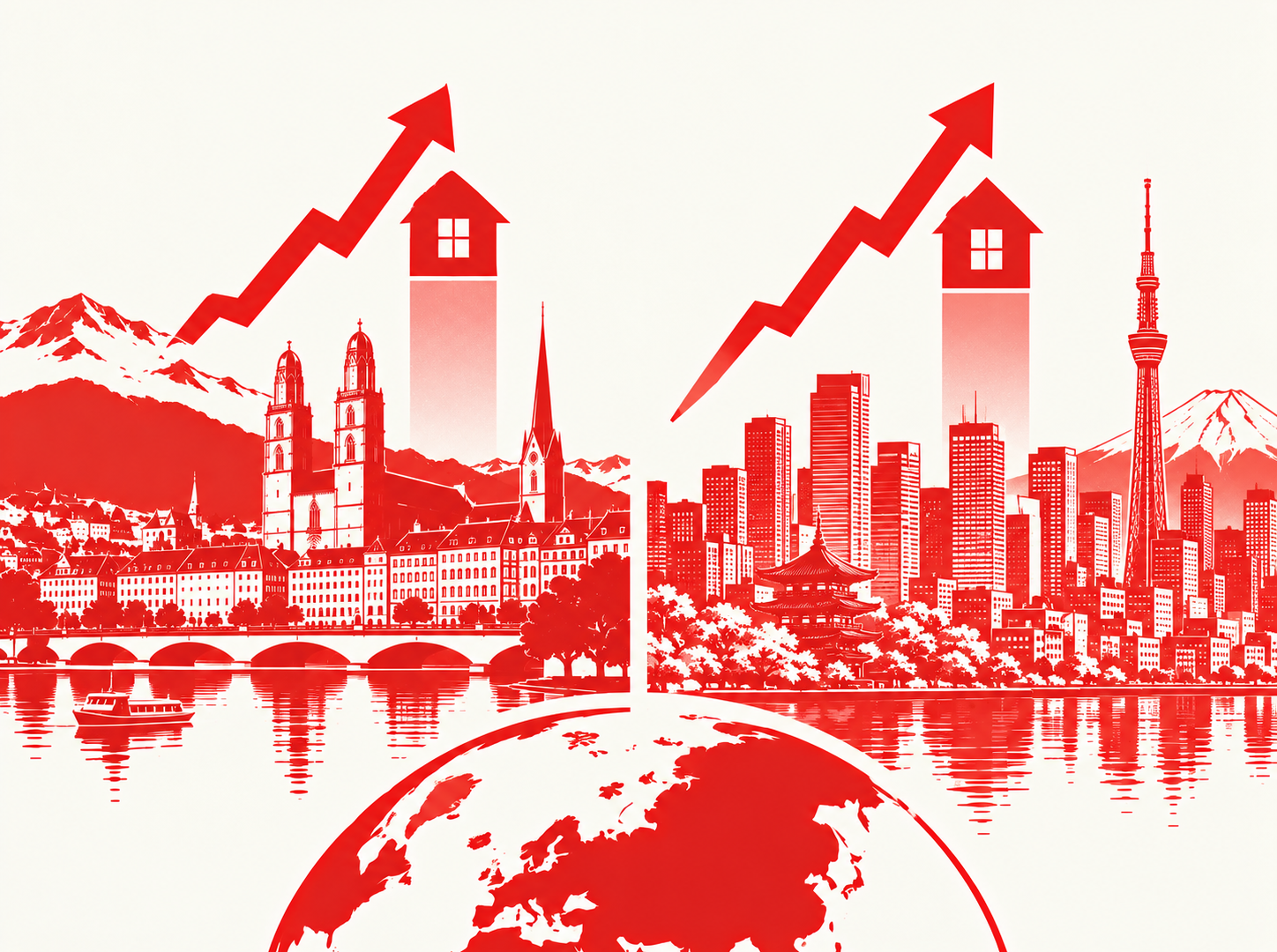
Zurich now carries the world’s highest risk of a residential property bubble, according to UBS’s latest Global Real Estate Bubble Index, with persistent housing scarcity, low financing costs and demand from highly paid international workers pushing the city above Tokyo and Miami.
The UBS index gives Zurich a score of 1.69, up from 1.55 a year earlier. That places the city at the top of the 23-market global ranking and firmly in UBS’s “high risk” category, alongside Tokyo, which is at 1.54.
Switzerland is not alone in confronting high prices, but its two largest international cities are increasingly exposed to global comparisons. Zurich is now UBS’s riskiest market worldwide, while Geneva’s risk score also climbed year-on-year. Geneva also remains in the high-risk group, with its score rising to 1.12 from 1.05.
Both cities combine constrained land and housing supply with high incomes, international demand and financing conditions that remain favourable for existing property owners.
Why Zurich And Tokyo Are In The High-Risk Category?
UBS’s index does not predict the date or size of a housing-market crash. Instead, it measures whether home valuations are vulnerable to a correction by comparing property prices with local incomes, rents, economic output, credit growth, and construction activity. A bubble is defined as a substantial, sustained overvaluation, something that often becomes fully apparent only after prices reverse.
The 2026 study classifies cities as low, moderate, elevated, or high risk. Zurich and Tokyo are the only markets in the highest category; Miami, which was among the riskiest markets in earlier editions, has fallen into the lower “elevated risk” band. Dubai, Seoul, Geneva and Lisbon also sit in that elevated-risk tier.
| City | UBS 2026 bubble-risk score | UBS category |
|---|---|---|
| Zurich | 1.69 | High risk |
| Tokyo | 1.54 | High risk |
| Miami | 1.41 | Elevated risk |
| Geneva | 1.12 | Elevated risk |
| Paris | 0.33 | Moderate risk |
| London | 0.30 | Moderate risk |
| New York | 0.28 | Moderate risk |
| San Francisco | -0.02 | Low risk |
| São Paulo | -0.24 | Low risk |
Two Decades Of Rising Prices
Zurich’s ascent is rooted in a long-running imbalance between demand and supply. UBS says the city has recorded the strongest increase in residential prices of any market in its sample over the past 20 years. Its position as a business and financial centre, increasingly reinforced by technology and artificial-intelligence employers, continues to attract highly skilled international workers competing for a limited stock of homes.
The affordability gap is now unusually severe.
UBS calculates that buying a typical Zurich apartment requires the equivalent of roughly 46 years of rent, the highest price-to-rent ratio in the entire 23-city study. Geneva ranks second on that measure at around 40 years of rent.
The price pressure is not evenly shared across the city. UBS notes that worsening affordability has widened the divide between the most sought-after neighborhoods and the broader market, meaning prime locations have become increasingly inaccessible even by Zurich standards.
“Zurich’s vacancy rate is close to zero in city-level term”
The supply side remains the key constraint. Zurich’s vacancy rate is close to zero in city-level terms, while the cantonal rate was just 0.52% in 2026, up marginally from 0.48% a year earlier but still well below the 1% level generally associated with a more balanced rental market. The number of vacant homes rose from roughly 3,800 to 4,200, but this was insufficient to ease competition meaningfully.
Owner-occupied housing construction also remains below historical norms. UBS identifies limited new supply, alongside low borrowing costs, as the main reasons bubble risk is continuing to rise in both Zurich and Geneva.
That creates a self-reinforcing problem: low vacancy increases rents, which makes home ownership appear comparatively attractive to households able to obtain financing; meanwhile, limited land, planning constraints, long approval processes and strong population growth limit the rate at which new supply reaches the market.
Read More: Cembra Set To Move Headquarters From Zurich To Baden: No Job Cuts – Helvetica Times
Lower Rates Add Fuel
Switzerland’s return to very low financing costs has made property purchases more attractive relative to renting for buyers with sufficient equity and income. UBS says low borrowing costs have continued to raise bubble risk in Zurich and Geneva, even as affordability for many households has deteriorated.
At the national level, however, UBS’s separate Swiss Real Estate Bubble Index still describes the market as carrying moderate, rather than elevated or acute, bubble risk. That index rose from 0.62 to 0.72 in the second quarter of 2026, extending a steady increase since late 2024, but UBS does not currently expect a nationwide price correction in the coming quarters.
The contrast is important: Zurich’s global ranking reflects the city’s exceptional price-to-income and price-to-rent pressure, whereas the nationwide measure captures a more diverse property market, including regions where prices, demand and available supply are less extreme.
Why A “Bubble Risk” May Not Be A Forecast Of Collapse
A high UBS index reading should not be read as a prediction that Zurich house prices will imminently fall. UBS says its measure flags market vulnerability, not timing. A correction normally requires a trigger: a rise in mortgage costs, recession and job losses, a sharp decline in population growth, a surge in construction, or a change in buyer sentiment.
Zurich’s market still has substantial supports. Switzerland has relatively conservative mortgage-lending standards, borrowers must meet affordability tests that assume substantially higher interest rates than their current mortgage costs, and the city’s chronic shortage of housing continues to underpin demand. Those factors may reduce the risk of a rapid, credit-driven crash even if valuations remain stretched.
But the ranking underlines a widening social and economic challenge: Zurich’s housing market is becoming increasingly difficult to access not only for lower-income residents, but also for middle-income households and the skilled workers the city needs to sustain its growth.