
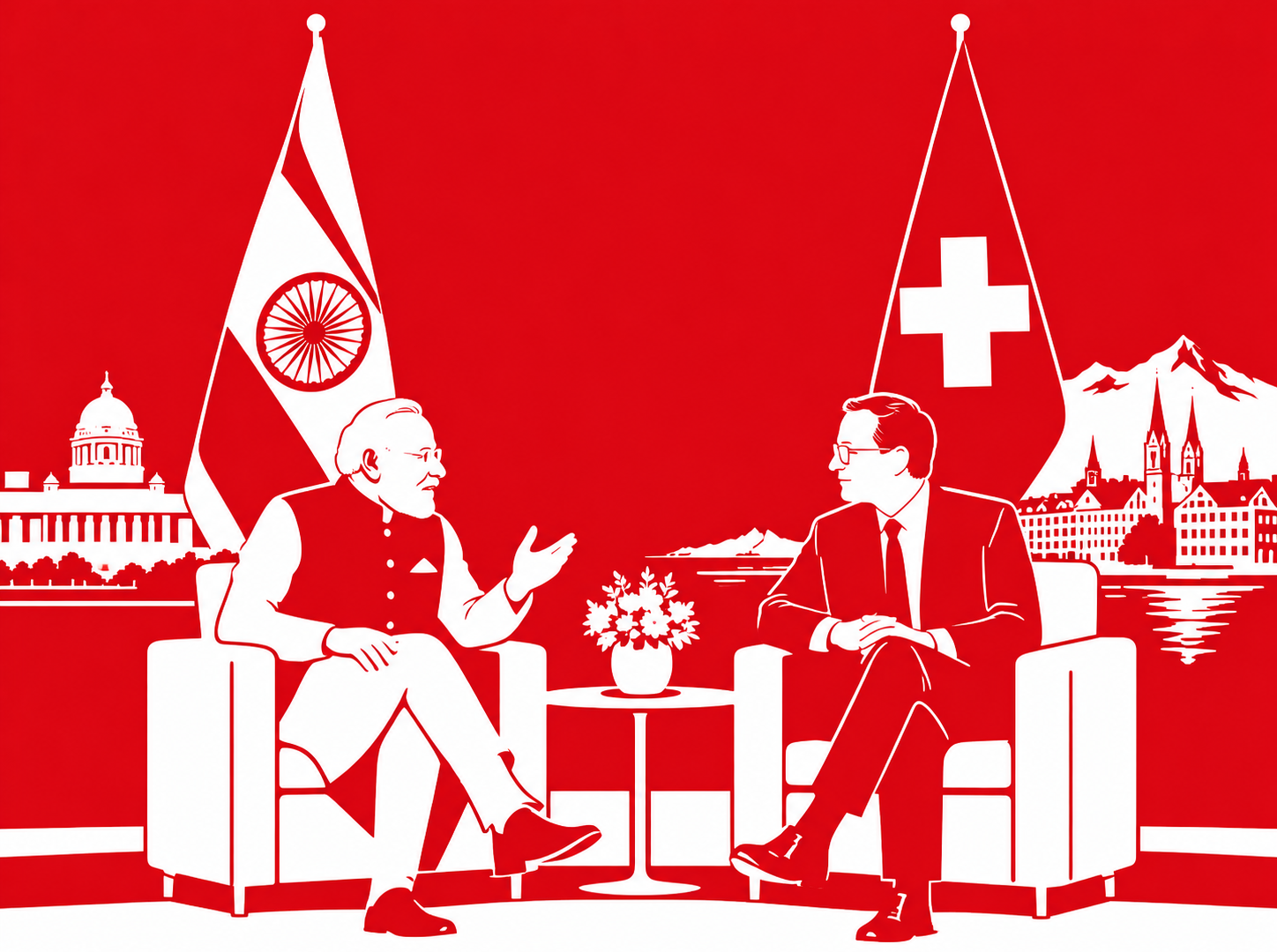
Switzerland and India signed agreements on migration and mobility and on exchanges for young professionals during Swiss President Guy Parmelin’s state visit to New Delhi on Monday. The agreements aim to create legal mobility pathways and allow young people from both countries to undertake professional training placements abroad.
Parmelin met Indian Prime Minister Narendra Modi and President Droupadi Murmu on the first day of his three-day visit. Talks with Modi covered economic relations, education, research, innovation and migration.
The migration agreement formalises cooperation on education, science and employment. It also covers readmission of people required to leave the country and joint action against irregular migration, human trafficking and document fraud, according to Switzerland’s Federal Department of Foreign Affairs.
Modi said the two countries would work together for global peace and stability, backing dialogue, diplomacy and reform of international institutions.
The leaders also discussed the war in Ukraine, conflicts in the Middle East, the United Nations and Switzerland’s role as a diplomatic platform.
Pleased to call on President Guy Parmelin @ParmelinG of the Swiss Confederation, visiting India on a State Visit.
Deeply appreciate President Parmelin’s sentiments towards deepening our partnership, building on the promise of India – EFTA TEPA.
Confident that his meeting… pic.twitter.com/fF0GuwdJvn
— Dr. S. Jaishankar (@DrSJaishankar) October 5, 2026
External Affairs Minister of India, Dr S Jaishankar, meets Guy Parmelin in New Delhi
Four EFTA Countries Have Committed To Facilitating USD 100 Billion In Investment In India Over 15 Years
The talks came as the India–EFTA Trade and Economic Partnership Agreement approaches its first anniversary. The agreement covers Switzerland, Norway, Iceland and Liechtenstein, and entered into force on 1 October 2025. Swiss officials said implementation was progressing as planned and that Swiss companies were showing strong interest in India.
The four EFTA countries have committed to facilitating USD 100 billion in investment in India over 15 years, with the potential to generate one million direct jobs. That is a long-term target, not investment already delivered or jobs already created.
Modi said the two countries had agreed to improve market access for Indian exports and facilitate investment.
Possible areas of cooperation include agriculture, pharmaceuticals, textiles and engineering on the Indian side. For Swiss companies, they include biotechnology, life sciences, financial services, food processing and sustainability.
India’s Ministry of External Affairs puts bilateral trade at roughly USD 23.35 billion in 2024–25.
Read More:Zurich Adds Anti-Discrimination Focus To 2026–2030 Integration Goals
Switzerland India Sign Agreements, Discuss AI And Global Affairs
Artificial intelligence was another focus.
Switzerland will host an AI summit in Geneva in spring 2027, following India’s AI Impact Summit in New Delhi earlier this year.
Parmelin described the Geneva meeting as a continuation of India’s initiative and stressed the need to include developing countries in international technology discussions.
Parmelin is travelling with a delegation of business and scientific representatives. His programme includes a visit to Noida International Airport, which is operated by a subsidiary of Zurich Airport, and meetings with Indian business and research representatives. The visit ends with the second India–EFTA Prosperity Summit on 7 October 2026.
Political Backdrop: Protests Over “Vote Theft”
The investment talks are taking place against a turbulent domestic backdrop. India has seen days of protests by opposition parties, student groups and civil-society organisations over alleged manipulation of voter rolls under the Election Commission’s Special Intensive Revision (SIR) process.
Protesters are demanding the resignation of Chief Election Commissioner Gyanesh Kumar and the suspension of the SIR, which they say has removed more than 130 million names from electoral rolls and could disenfranchise millions of voters. Opposition leaders, including Rahul Gandhi, have accused the government and the commission of “vote theft” and called for a return to paper ballots.
The Election Commission and Prime Minister Narendra Modi’s Bharatiya Janata Party reject the allegations. They say the revision is an independent effort to update voter rolls and remove ineligible entries, and deny any political motive.
The dispute has escalated beyond routine opposition politics. Police have detained Rahul Gandhi and other lawmakers during protests, while an opposition delegation has met President Droupadi Murmu to submit a memorandum demanding Kumar’s resignation. The opposition has also said it plans to approach the Supreme Court.
For foreign investors, the protests add a layer of political uncertainty. They do not directly affect the terms of the proposed investment treaty, but they highlight concerns about institutional independence and the rule of law—issues that matter to companies weighing long-term capital commitments in India.
Day 2-3: Switzerland And India Advance Investment Treaty Talks During Parmelin Visit
Finance Minister Nirmala Sitharaman and Swiss President Guy Parmelin discussed moving forward negotiations on a bilateral investment treaty in New Delhi.
India and Switzerland have agreed to continue negotiations on a Bilateral Investment Treaty (BIT), following a meeting between Indian Finance Minister Nirmala Sitharaman and Swiss President Guy Parmelin in New Delhi on Tuesday. India’s finance ministry described the talks as focused on advancing negotiations that it said would enhance investment flows and deepen economic engagement.
The meeting came during Parmelin’s three-day state visit, which also marked the first anniversary of the India-EFTA trade agreement.
A bilateral investment treaty is an agreement between two countries to promote and protect investments made by their investors in each other’s territory. Such treaties typically allow investors to take a sovereign government to arbitration if they believe their investment has been treated unfairly.
For Switzerland, a treaty would provide additional legal certainty for Swiss companies investing in India. For India, it would also matter for outbound investment: as Indian companies expand abroad, New Delhi has an interest in ensuring its investors receive comparable protection in partner countries.
The Five-Year Dispute Rule
The central sticking point is India’s 2016 model treaty, which requires a foreign investor to pursue domestic remedies for five years before initiating treaty-based arbitration. That waiting period has drawn growing criticism from investors and legal practitioners.
India terminated bilateral investment treaties with dozens of countries after adopting the 2016 model, following adverse arbitral awards. One estimate cited by PropNewsTime puts the number of treaties in force at eight by 2021, down from 73 in 2015.
India has already moved on this issue in at least one case. Its 2024 treaty with the United Arab Emirates reduced the local-remedies period from five years to three.
What Remains Unresolved?
Tuesday’s meeting produced a statement of intent, not a concluded agreement. India’s finance ministry did not say whether the two sides had narrowed differences on the five-year local-remedies requirement, arbitration procedures, compensation standards, or the scope of protected investments.
That gap matters. The five-year rule is the issue most likely to determine whether Swiss investors see the treaty as meaningful protection or as a symbolic commitment. Until India and Switzerland publish a draft or agreed text, the practical impact remains unclear.