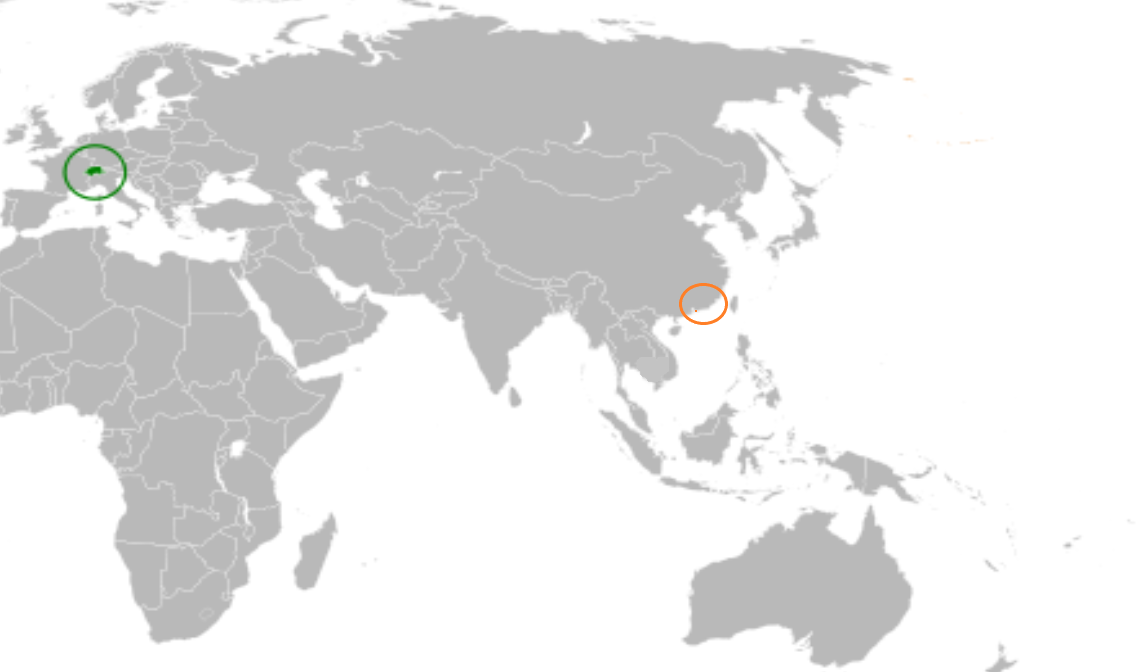
Hong Kong has overtaken Switzerland as the world’s largest cross-border wealth hub, marking a symbolic shift in the global private banking map and a new challenge for one of Switzerland’s most important financial industries. A Boston Consulting Group report said cross-border wealth booked in Hong Kong reached $2.95 trillion at the end of 2025, just ahead of Switzerland’s $2.94 trillion.
Switzerland’s client base is oriented toward Western European markets, with less exposure to the fast-growing market inflows that powered rivals, though that positioning may prove an advantage as geopolitical uncertainty reaffirms Switzerland’s role as a core global booking center, attracting flight-to-safety flows from more volatile regions such as the Middle East. Growth is expected to average around 6% annually through 2030.
The change ends a long period in which Switzerland, especially Zurich and Geneva, was the natural centre for offshore wealth booking.
For decades, Swiss private banks, wealth managers, trustees, lawyers, and family offices have benefited from the country’s stability, legal certainty, and deep financial expertise. Hong Kong’s rise shows how fast the balance is shifting towards Asia.
BCG said global financial wealth rose 10.7% in 2025 to $333 trillion, the fastest growth since 2021. It expects emerging markets to add nearly $7 trillion in financial wealth by 2030, with India, Brazil and Mexico among the main contributors. That growth is reinforcing the pull of Asian wealth hubs, particularly Hong Kong and Singapore.
Read More:Who is Beat Jans? Why is he fighting the population cap vote?
Asia’s Wealth Shift: Factors Driving Hong Kong’s Rise
Wealth creation in Asia has accelerated; mainland Chinese capital continues to flow through the city, and local equity markets have recovered strongly. In BCG’s view, the combination has made Hong Kong increasingly hard to dislodge as the region’s main cross-border booking centre.
Asia-Pacific remained a key engine of growth, supported by its central role in the AI supply chain, from semiconductor exports in South Korea to accelerating data center investment across Southeast Asia, and strong equity market performance in Hong Kong and Japan. Mainland China led the region, with financial wealth expanding by 15% in 2025 and projected to grow at 9% annually through 2030.
That matters because cross-border wealth is not just about where money is parked. It also supports private banking, asset management, legal services, fund administration and a wide range of professional jobs. As wealth moves, the supporting ecosystem tends to follow.
BCG also expects the lead to widen over the next few years. It forecasts annual cross-border wealth growth of about 9% for Hong Kong and Singapore, compared with roughly 6% for Switzerland. If that trend holds, Switzerland’s relative position could weaken further even if the country remains a major wealth-management centre in absolute terms.
For Switzerland, Ranking Loss Is As Much About Perception As Volume?
Switzerland remains one of the world’s strongest financial centres, with deep expertise in private banking, asset protection and wealth structuring. But losing first place in a category that Switzerland has long treated as part of its financial identity is still a reputational blow.
The Swiss wealth-management industry faces a more competitive environment than it did a decade ago. Singapore has emerged as a major rival, Hong Kong has regained momentum, and clients are increasingly demanding digital tools, tax transparency and multi-jurisdictional advice. Will this force Swiss institutions to adapt their offerings and sharpen their international focus?
The broader question is whether Switzerland can retain its premium positioning as wealth flows diversify away from Europe. The answer will depend partly on regulation, partly on performance and partly on whether Swiss institutions can keep serving global clients at the level they now expect.
The timing is important because the wealth industry is already in transition.