
New research from ETH Zurich and Leipzig University finds that a 3°C warmer world, previously treated as the outer edge of what climate scientists could confidently model, is now the most probable outcome under current policies, with global warming potentially reaching 3.25°C by 2100.
Last year, MeteoSwiss and ETH Zurich jointly published Climate CH2025, a report outlining three warming scenarios for Switzerland: 1.5°C, 2°C, and a severe 3°C scenario that represented the limit of what models could describe with confidence. The new study, published in the journal Earth’s Future in August 2026, concludes that the 3°C scenario is no longer an extreme outlier but the most likely trajectory absent immediate, drastic emissions cuts.
“For any emission trajectory without immediate and drastic emission cuts, we expect warming to be 25% higher,” said Gergana Gyuleva, a doctoral researcher in the climate physics group at ETH Zurich and the study’s lead author.
She stressed that the revision changes the timeline and probability of reaching a 3°C world, not what that world would actually look like.
This shift isn’t confined to a single research team. A 2024 survey of 211 IPCC authors found 42% already expected warming of 3°C or more by century’s end.
Switzerland Already Got A Preview This Year
The study’s more severe projection stems from a methodological revision. Traditional climate predictions rely heavily on historical warming rates tied to rising atmospheric CO2. But researchers found that natural climate variability, including recurring Pacific cooling patterns like La Niña, happened to suppress warming during the exact historical period used to calibrate many models.
“We were actually statistically unlucky for having caught a period where variability produced less warming in the real world,” Gyuleva said. To correct for this, the study incorporates satellite measurements tracking Earth’s energy imbalance (the gap between sunlight absorbed and heat radiated back to space) which has more than doubled since 2000.
Gyuleva acknowledged this is the weakest link in the analysis, since the satellite record only spans 25 years, making long-term comparisons difficult. To test robustness, she reran the analysis using only the outgoing-heat data, the half of the model researchers trust most, and got the same result.
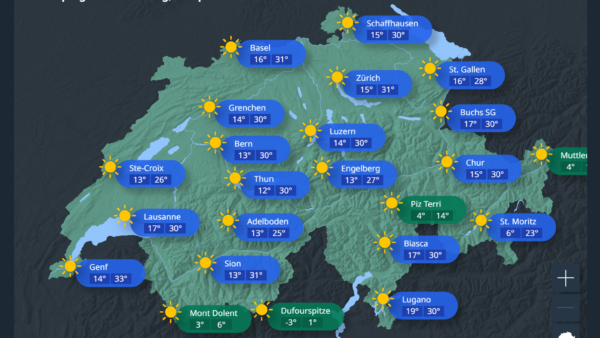
Switzerland just lived through its hottest and driest summer since records began in 1864, and by nearly every measure it surpassed the historic 2003 heatwave that killed an estimated 1,000 people in Switzerland and roughly 70,000 across Europe.
The numbers are stark compared to 2003:
Basel-Binningen set an all-time national heat record of 39.7°C and endured 20 consecutive days above 30°C. Locarno recorded 24 consecutive such days, itself a national record. Rainfall in Basel across the summer months totaled just 82.8 millimeters, roughly half of what fell during the summer of 2003.
Notably, the Climate CH2025 scenarios projected around 30 heat days above 30°C for the Zurich area in a typical 3°C-world summer. This year, Zurich hit 38, already exceeding what scientists had modeled as a future norm.
Sonia Seneviratne, head of the Institute for Atmospheric and Climate Science at ETH Zurich and a co-author of the national scenarios, said the summer’s intensity wasn’t surprising given the trend: heatwaves were rare before 2003, but have become a recurring seasonal feature since 2018, with summer itself lengthening at both ends, now running from June through September.
Switzerland Warms Faster Than The Global Average
Because Switzerland warms faster than the worldwide mean, a 3°C global scenario would translate to roughly 4.9°C of local warming, an amplification effect that makes the country particularly exposed to the study’s findings.
The study’s revised assumptions mean the world’s remaining global carbon budget — the total CO2 that can still be emitted before crossing a given temperature threshold — has shrunk by about a fifth. Even so, researchers emphasize this isn’t a verdict on inevitability. Severe emissions cuts could still halve the projected warming, according to Gyuleva.
In practice, she said, this requires cutting global emissions by half by around 2030 and reaching net zero by 2050 at the latest, primarily by eliminating oil, gas and coal dependence. For Switzerland specifically, Seneviratne pointed to replacing petrol vehicles with electric ones, replacing oil and gas heating with heat pumps or geothermal systems, and scaling up solar, wind and hydropower — since transport and buildings together account for more than half of Swiss greenhouse gas emissions.
Switzerland has committed to halving emissions by 2030 against 1990 levels and reaching net zero by 2050, but has cut emissions by just over a quarter so far. Environment Minister Albert Rösti acknowledged in August 2026 that the country would probably miss its 2030 target. A separate, newly released UNEP report reinforces the same tension in different terms: under governments’ currently adopted policies, it projects about 2.6°C of warming by 2100, falling to roughly 1.8°C if every national pledge and net-zero commitment were fully delivered.
A Call For “Positive Narratives”
Gyuleva argued that fear-based messaging alone is counterproductive, echoing a point made in the original CH2025 report. She offered concrete Swiss examples of climate action with tangible side benefits: electric vehicles charging overnight can double as grid storage, cities grow quieter and cleaner as combustion vehicles decline, and reducing (not eliminating) meat and dairy consumption could improve food quality, cut imported animal feed, and reduce nitrate pollution in groundwater.
“Society needs positive storylines, positive visions of the future that are doable,” Gyuleva said. “And they are.”
Read More: Should You Raid Your Retirement Savings for a Swiss Home Down Payment?