Switzerland’s benchmark Swiss Market Index gained 1.23% on Monday, 21 September 2026, closed essentially flat on Tuesday, and was up roughly 0.09% by midday Wednesday, with the dominant story of the 48-hour window not being a single index move but a political fight in Bern over how much extra capital UBS must hold.
The SMI closed at 13,956.58 points on Monday, up 169.86 points or 1.23%, after trading between 13,849.68 and 13,983.56 during the session on volume of roughly 16.2 million shares.
The move came alongside a broader improvement in global risk appetite, with softer crude oil prices and easing global bond yields supporting equities that day.
Tuesday: a pause, and a bigger UBS story than the tax settlement
The index barely moved on Tuesday, September 22, slipping 3.19 points, or 0.02%, to close at 13,953.39.
The day’s real UBS news had two parts, and the more consequential one was regulatory rather than legal. UBS announced it had reached a €5 million settlement with the Dutch Public Prosecution Service over a legacy Credit Suisse-era matter, resolving allegations that Credit Suisse had helped 12 former Dutch clients conceal savings and file incorrect tax returns between 2005 and 2015 using numbered accounts, aliases and opaque corporate structures.
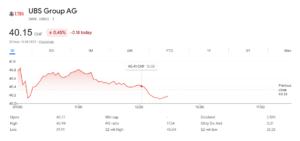
But the settlement was quickly overshadowed by a much larger fight: Switzerland’s Council of States (Ständerat) was weighing new capital rules that could force UBS to hold significantly more capital against its foreign subsidiaries — potentially requiring the bank to raise on the order of USD 20 billion in additional CET1 capital. UBS shares fell as investors weighed the risk of a stricter outcome, with one financial outlet’s headline that day reading “UBS-Aktie schwächer: Positionspapier gegen zu strenge Kapitalregeln” (UBS shares weaker: position paper against overly strict capital rules).
Wednesday: capital rules vote resolves — and UBS shares actually rise
By Wednesday, September 23, the picture flipped. The Council of States confirmed it would require 90% risk-weighted capital backing for UBS’s foreign holdings, a demanding outcome, yet UBS shares traded higher regardless, up 0.35% to 0.50% around midday at CHF 40.47–40.53, based on real-time SIX data. The corresponding headline captured the market’s reaction directly: “UBS-Aktie trotzdem fester: Ständerat will 90% Eigenkapital für UBS-Auslandbeteiligungen” (UBS shares firmer regardless).
The broader index also advanced. The SMI opened 0.336% higher at 14,000.25 points, following Tuesday’s 13,953.39 close, then eased back somewhat, trading at 13,961.04 by 12:09 CEST and 13,965.78–13,966.00 by around 12:26 CEST, up about 0.09% on the day. The session’s range spanned an intraday low of 13,947.11 and a high of 14,031.29. 1436 The morning rally was supported by hopes for progress toward resolving the conflict in the Middle East, alongside falling oil prices.
Wednesday’s actual top and bottom SMI performers: From Nestle to Swiss Re
Based on real-time midday data, the strongest and weakest individual stocks in the SMI were:
UBS also had the highest trading volume in the index at midday, with more than 2.38 million shares changing hands via SIX. 1436
Switzerland’s move contrasted with a mixed global backdrop: the Dow Jones had closed 0.36% lower at 51,863.69 the prior session, while the Nasdaq Composite gained 0.45% to 27,244.28; Germany’s DAX traded largely sideways on Wednesday, and Asian markets were mixed.
As of Wednesday’s midday trading, the SMI was up 5.39% year-to-date in 2026, with a 2026 high of 14,669.51 and a 2026 low of 12,053.51. Total market capitalization of SMI constituents stood at roughly €1.587 trillion. A year earlier, on September 23, 2025, the SMI stood at 12,102.61 — meaning the index has risen approximately 15.4% over the past twelve months.
Read More: Large Fire Breaks Out In Buchs Zurich