Lake Zurich has fallen to its lowest water level since 1952, as Switzerland’s ongoing drought forces authorities to restrict outflows and cancel boat services around the lake.
On 18 August 2026, Tuesday evening, the lake’s water level stood at 405.45 metres above sea level, roughly half a metre below the typical August level. The canton of Zurich expects the level to drop by up to a further 15 centimetres by the end of August, with no sign of the drought easing in the near term.
The situation has pushed authorities into uncharted regulatory territory. Lake Zurich’s water level is typically managed by controlling inflows and outflows, but it has already fallen below the specified low-water limit, meaning current conditions are outside the scope of existing regulations. To protect the lake as much as possible, authorities have significantly reduced the outflow into the Limmat River. That reduction, however, creates its own problem: releasing less water into the Limmat puts increasing stress on fish and other aquatic life downstream.
Read More: Switzerland Drought Strains Waterways
Lake Zurich Boat Services Cancelled And Curtailed
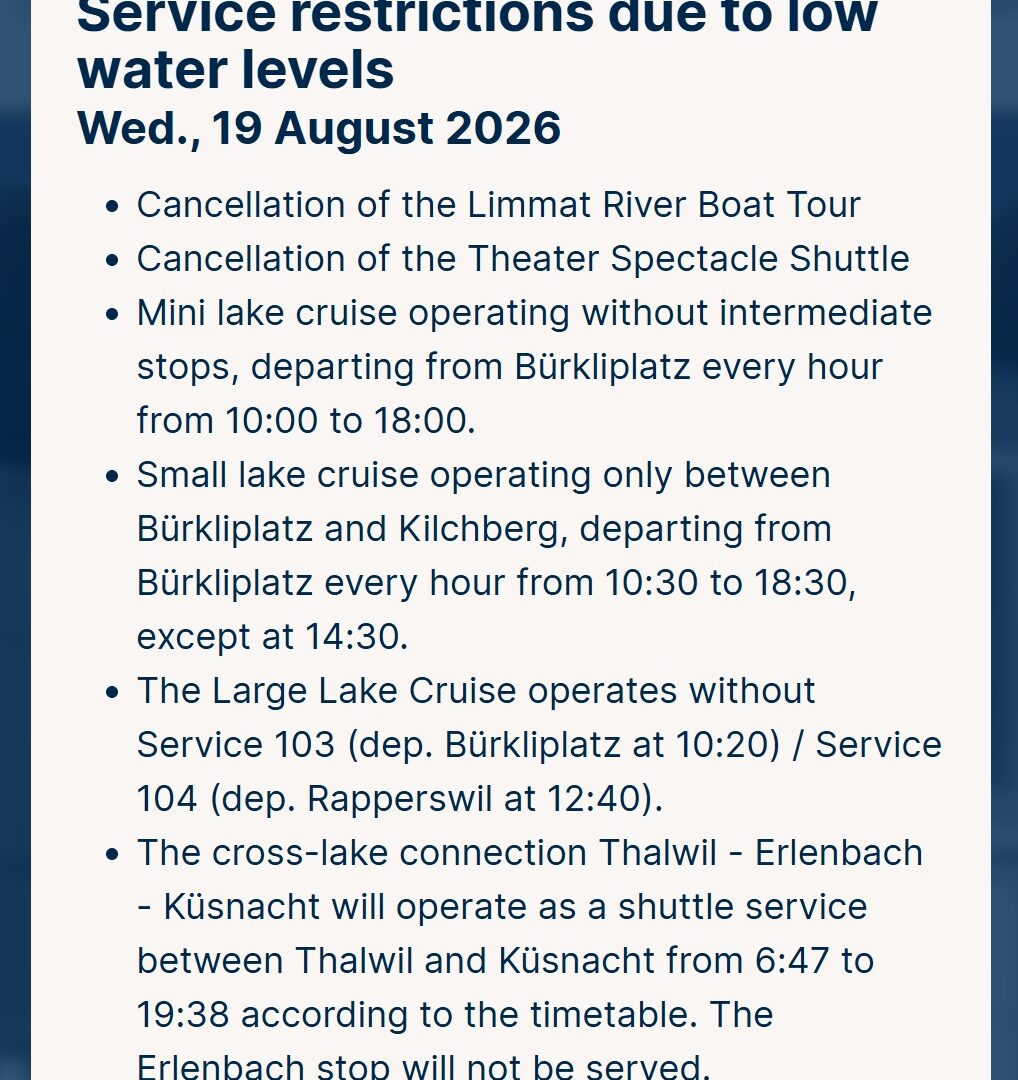
The falling water level has already had visible effects on lake traffic. The Lake Zurich Navigation Company (ZSG) suspended its Limmatboat sightseeing tours in mid-August, and further services are now being cancelled. According to ZSG, the shuttle service to a theatre production and additional routes will no longer operate for the time being.
The low water is also causing concern for private boat owners. Several municipalities along Lake Zurich have urged owners in recent days to check their moorings regularly, warning that many harbour facilities were not built to handle such low water levels.
Lake Zurich’s Decline Is One Symptom Of A Broader Drought Affecting Waterways Across Switzerland
In July, the Federal Office for the Environment (FOEN) recorded historically low water levels at 11 monitoring stations on rivers and streams. Between April 1 and July 31, roughly one-fifth of all monitoring stations recorded their lowest levels on record for the corresponding season, with the Swiss Plateau and Jura region particularly affected.
North of the Alps, river flows in many locations are running at levels statistically expected only once every two to ten years, according to FOEN. In some places, such as the Doubs near Ocourt in canton Jura and the Rhine near Basel, conditions this severe occur only once every 30 to 100 years, or even less often. Both rivers have remained below their long-term average flow since the start of the year, with the exception of February.
Beyond Lake Zurich, unusually low water levels have also been recorded at Lake Constance, Lake Walen, Lake Zug, Lake Maggiore, Lake Sempach and Lake Hallwil, underscoring how widely the drought is affecting Switzerland’s lakes and rivers this summer.