
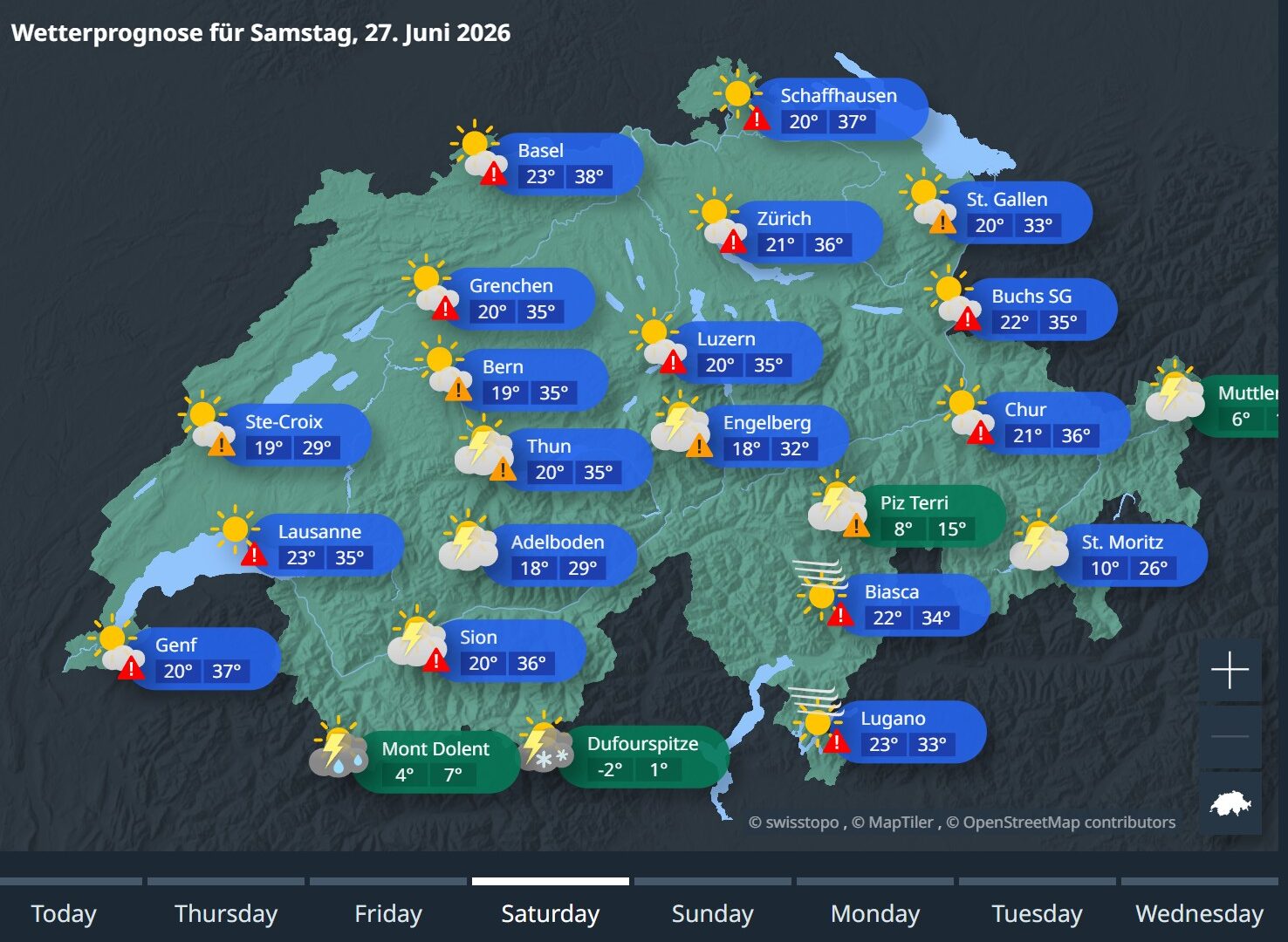
Switzerland is in the grip of what MeteoSwiss has described as a “historic” heatwave, with temperatures forecast to reach up to 38°C in some areas before the heat gradually eases into next week, bringing relief after one of the most intense early-summer heat events in living memory.
The high-pressure system dominating Central and Northern Europe has locked warm, dry air over the Alpine region for days, and forecasters say the peak is still to come.
MeteoSwiss Issues Heat Warnings At Level 3 Out Of 5, Classified As “Significant Risk”
MeteoSwiss has issued heat warnings at level 3 out of 5, classified as “significant risk,” across nearly the entire country, with an elevated warning in the Basel region. The agency describes the weather as “sunny, very hot and muggy” every day through the week, with afternoon and evening thunderstorms possible in the Alps, particularly on Friday.
Temperature peaks by region through the week are forecast as follows:
-
Basel: up to 36–38°C — the hottest spot in Switzerland, where some weather models show 38°C possible by late in the week, threatening the all-time Swiss June record of 36.9°C set in Basel-Binningen in 1947
-
Geneva and Sion: 35–36°C
-
Lausanne and Bern: around 34°C
-
Zürich: highs around 35–36°C, with the June record at Zürich Airport also under threat
-
Lugano: records potentially threatened there too
Nights will offer only partial respite. Temperatures overnight are forecast between 17°C and 22°C, meaning some areas will experience tropical nights, where temperatures remain above 20°C, making sleep difficult and posing health risks for vulnerable groups.
The hottest conditions in the lowlands are expected to concentrate in Valais, the Geneva region, Basel and parts of the Aare Valley.
Switzerland’s Historic Heatwave: Records In The Crosshairs
MeteoSwiss forecasters have flagged a real possibility that multiple June temperature records could fall this week. The national June benchmark, 36.9°C, set at Basel-Binningen on 27 June 1947, has survived for nearly eight decades. Some weather models place the Basel peak at 38°C, which would smash it by more than a degree. Even the more conservative forecasts of 36–37°C would represent an extraordinary June reading.
Records are also under threat at Zürich Airport and in Lugano.
Switzerland’s federal and cantonal health authorities issue standard guidance during heat alerts of this level: stay hydrated, avoid the midday sun, check on elderly neighbours, and keep living spaces cool during the night. Those most at risk include the elderly, young children, people with chronic illness and outdoor workers.
Relief On The Horizon?
There is relief on the horizon, though it will arrive gradually. The high-pressure system is expected to weaken over the weekend, with a disturbance zone moving in. From next week, the weather will become more unsettled: sunny periods alternating with cloud, occasional rain and thunderstorms in the afternoons, and temperatures easing to between 28 and 34 degrees, still warm by any normal standard, but a meaningful step down from the peak.
MeteoSwiss currently forecasts this more moderate pattern continuing until at least 5 July 2026.
Read More: Zürich City Hospital’s Delivery Robots Pass The Test