
Switzerland’s office property market has stabilised after years of pressure from home working, but artificial intelligence could become the sector’s next major challenge, according to a new study by Raiffeisen Switzerland.
The bank estimates that demand for office space could fall by between 1.6% and 7.9% over the next five years as AI changes the structure of office employment.
“So far, employment data does not indicate a widespread reduction in office jobs. However, differences are emerging between individual occupational groups,” Fredy Hasenmaile, Chief Economist of Raiffeisen Switzerland.
“In sectors particularly exposed to artificial intelligence and offering limited potential for human-machine collaboration, employment is developing more slowly than in areas where AI primarily provides support.”
Read More: Data Leak Exposes 1320 UBS Employees Facing Layoffs
Office Market Shows Signs Of Recovery
The Swiss office market has faced sustained pressure since the coronavirus pandemic, as working from home reduced companies’ need for desks and traditional office space. However, the market has so far avoided a widespread collapse.
Employment growth in office-intensive sectors, limited new construction and companies tightening their home-working policies have helped support demand, said Hasenmaile. Asking rents have recovered after several difficult years, while newly marketed space continues to be absorbed. The amount of advertised office space has also fallen significantly.
According to Raiffeisen, office vacancy rates have declined from 9.5% in the fourth quarter of 2019 to around 7.5%. The bank said supply has fallen by roughly one-quarter from its pandemic-era level, helping the market remain relatively balanced.
Next Stress Test: AI Could Cut Swiss Office Demand
The next challenge could come from the rapid adoption of AI. Raiffeisen analysed around 600 occupational groups and found that roughly two-thirds of office workers are employed in roles heavily exposed to the technology.
The impact will depend on whether AI replaces employees or supports them, Hasenmaile said. So far, employment data does not point to a broad-based decline in office jobs. However, employment is growing more slowly in occupations where AI exposure is high and there is limited scope for collaboration between people and machines.
Finance, IT services and public administration are among the sectors considered particularly exposed. Major economic and headquarters locations, including Zurich, Zug, Geneva and Ticino, could therefore face greater pressure in the office property market.
Raiffeisen said property owners and developers should prepare for changes in how buildings are used. Possible responses include refurbishing buildings, adapting layouts, developing new property strategies or converting some office space to other uses.
The bank’s 1.6%–7.9% projection represents a moderate scenario. It also refers to wider possible outcomes, ranging from a 22% decline in office-space demand under strong automation to a 14% increase in a more favourable scenario. Raiffeisen stressed that long-term forecasts remain difficult because the eventual effect of AI will depend on adoption rates and whether the technology complements or replaces human labour.

Meanwhile, Home Ownership Remains Cheaper Than Renting
Raiffeisen’s report also examined the residential property market. Despite high purchase prices, owning a home remains cheaper than renting in many parts of Switzerland, with housing costs up to 25% lower depending on the region and financing structure.
However, demand is losing momentum. Marketing periods are becoming longer and the number of financed transactions has recently declined slightly. Limited supply is still supporting prices, but Raiffeisen said the strongest phase of price growth in the owner-occupied market may have passed.
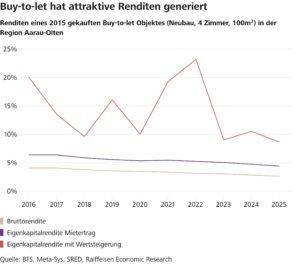
Buy-to-let investments are also becoming more demanding. Property owners face risks from vacancies, missed rental payments and administrative costs, while purchase prices have risen faster than achievable rents. That has put pressure on initial rental yields.
Hasenmaile said new buy-to-let investments increasingly depend on interest-rate conditions and future price gains. Investors seeking returns comparable with stocks or indirect property investments may need sustained increases in property values — something that is not guaranteed if price growth slows.
For now, Switzerland’s office market remains resilient. But Raiffeisen’s analysis suggests that the sector’s ability to withstand home working does not mean it is insulated from the next transformation in employment: AI-driven changes to the number, type and location of office jobs.