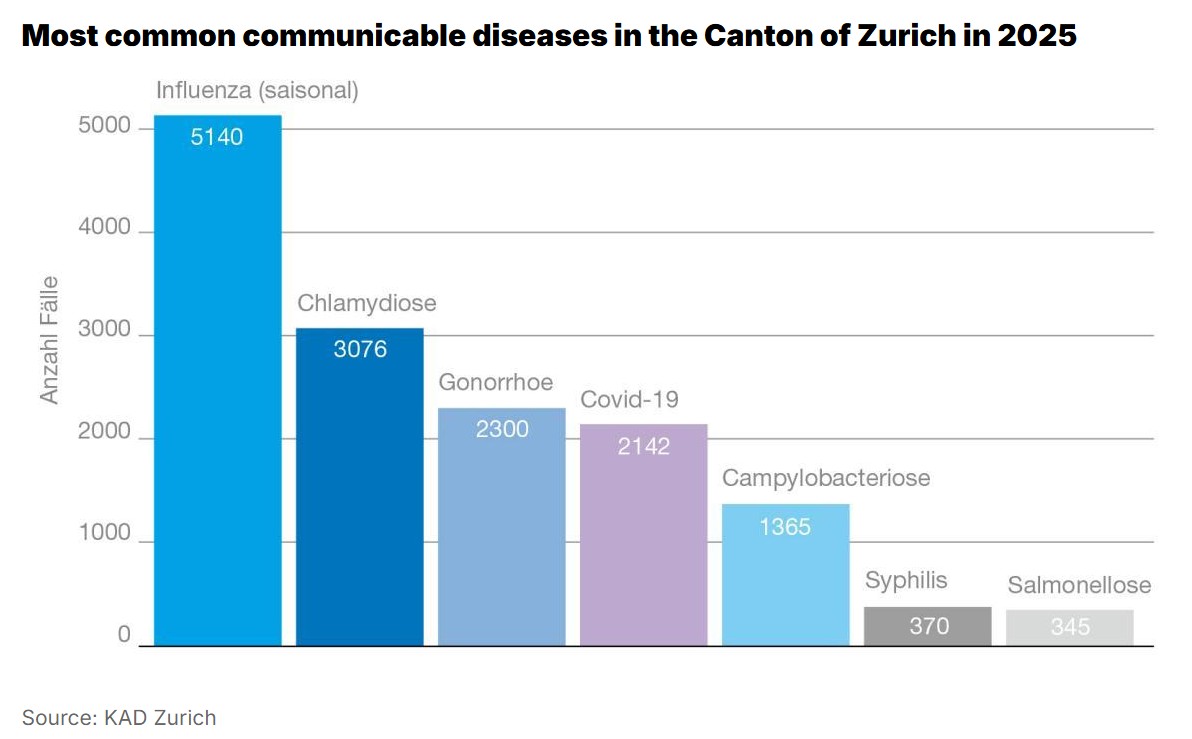
The Canton of Zürich’s Cantonal Medical Service (KAD) registered 17,042 cases of 34 different communicable diseases in 2025. Chlamydia and gonorrhoea together ranked among the top reported diseases, with syphilis cases also recorded, though significantly lower in number.
Authorities say prevention, through vaccination, sexual health education, and food safety, remains the most powerful tool available.
The figures, published in the KAD’s annual overview, span a wide spectrum of diseases subject to mandatory reporting under Switzerland’s Epidemics Act.
Under that law, certain communicable diseases must be reported to cantonal health authorities, enabling early detection, surveillance, and rapid containment of outbreaks.
What Dominated The Numbers
Three disease categories accounted for the bulk of reported cases in 2025:
-
Respiratory illnesses — led by seasonal influenza, the single most frequently reported condition in the canton
-
Sexually transmitted infections (STIs) — chlamydia and gonorrhoea together ranked among the top reported diseases, with syphilis cases also recorded, though significantly lower in number
-
Diarrhoeal diseases — campylobacteriosis and salmonellosis rounded out the most common categories
Less frequent but closely watched were cases of diphtheria, Zika virus infection, and dengue fever. While their numbers remain comparatively low, authorities note that international travel and shifting climatic conditions make these diseases an enduring public health concern, particularly tick, and mosquito-borne illnesses as warming temperatures expand the range of disease-carrying insects.
With 34 distinct diseases on the mandatory reporting list, the KAD’s surveillance work spans a broad and constantly evolving landscape. Authorities say the 2025 figures confirm that the pressure from communicable diseases shows no sign of easing, and that sustained investment in preventive public health infrastructure is not optional, but essential.
Read More: Zürich City Hospital’s Delivery Robots Pass The Test
The Case For Prevention
The KAD stresses that no single measure is sufficient — effective control of communicable diseases requires a combination of prevention, surveillance, and rapid outbreak response. Key pillars include:
-
Vaccination — effective vaccines exist for a significant proportion of notifiable diseases, including seasonal influenza and hepatitis B. The Federal Office for Health and Food Safety (AFG) supports vaccination in line with the Swiss national vaccination plan, including through targeted vaccination programmes.
-
Sexual health — the AFG, together with specialist institutions, runs the national programme Stop HIV, Hepatitis B, Hepatitis C Virus, and Sexually Transmitted Infections, which funds preventive measures against STIs across Switzerland.
-
Food safety — when foodborne disease outbreaks are suspected, the KAD works in close coordination with other cantonal agencies to trace and eliminate sources of infection as quickly as possible.
-
Disease-specific responses — these include environmental investigations for Legionella and local awareness campaigns for diseases transmitted by mosquitoes and ticks.