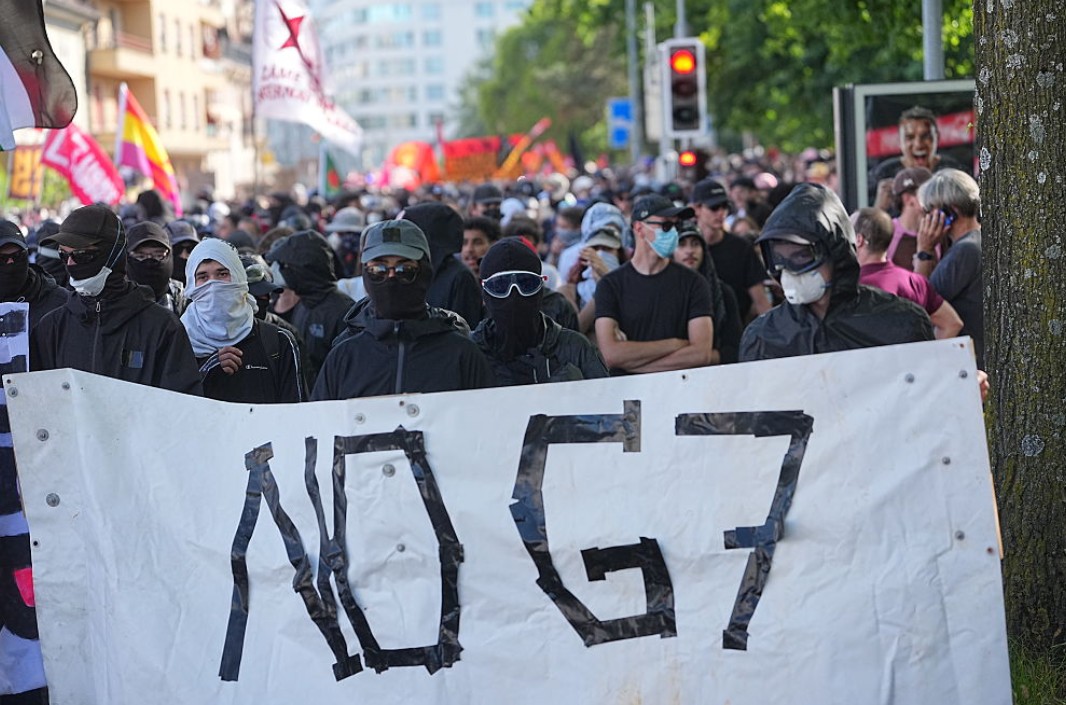
A large anti-G7 demonstration in Geneva descended into violence on Sunday, 14 June, as a minority of Black Bloc militants broke from the main march, attacking buildings, setting cars alight and clashing with police, forcing authorities to disperse the crowd with tear gas and water cannons on the eve of the summit in neighbouring Evian.
Tension escalated sharply when a faction broke away from the main march near the European headquarters of the United Nations on Geneva’s Rue de Varembé. Protesters hurled bottles, stones, cement blocks and fireworks at security forces. Buildings close to the UN campus were damaged. A Tesla was set on fire, with “Eat the Rich” spray-painted on its side. A bank’s windows were smashed.
Swiss police responded with tear gas and water cannon, eventually ordering the full dissolution of the march. The confrontation extended into the evening hours, with running clashes continuing as dusk fell.
On Friday evening, before the main Sunday demonstration, approximately 20 protesters had already been detained during earlier actions. Ahead of the event, police had also confiscated a series of dangerous objects from protesters near the march route, including knives, axes, gas canisters and powerful pyrotechnical devices.
🚨🇨🇭 GENEVA DESCENDS INTO CHAOS
The streets look like a WAR ZONE as radical left-wing protesters tear through the city during the G7 summit.
Cars BURN, businesses are smashed, and police fire tear gas and rubber bullets as the city erupts into MAYHEM. pic.twitter.com/uuKzIrzz3Q
— Global Dissident (@GlobalDiss) June 14, 2026
20,000 on the Streets, 600 In Black Bloc
The G7 summit, hosted by France at the lakeside resort of Évian-les-Bains from 15 to 17 June, brought the leaders of the US, UK, France, Germany, Italy, Japan and Canada to the southern shore of Lake Geneva, directly across the water from the Swiss city, setting the scene for one of Switzerland’s most significant domestic security operations in years.
The authorised No-G7 demonstration began peacefully in the early afternoon. Police spokesperson Alexandre Brahier confirmed that approximately 20,000 people participated in the march, though organisers claimed the crowd was significantly larger.
Among the protesters, Brahier identified around 600 Black Bloc militants, hardcore anarchist activists who typically dress in black and use demonstrations as cover for property destruction.
Read More: G7 Summit: France Bans Protests Leaving Geneva To Absorb Activist Pressure
Geneva’s G7 Protests Turn Violent: Hundreds Identified, Prosecutions Expected
As the demonstrations wound down, authorities confirmed that several hundred people had had their identities recorded by police, with some likely to face criminal prosecution.
Laurent Paoliello, spokesperson for the relevant cantonal authority, told local media: “Several hundred people will have their details recorded and some may be detained for criminal proceedings”.
The Geneva State Prosecutor’s office had prepared for exactly this scenario. Prosecutor-General Olivier Jornot had warned in May that his office was operating on the basis of the “worst-case scenario”, having doubled or tripled its normal staffing levels for the period, with up to six prosecutors on standby daily.
The security deployment on the Swiss side alone was extraordinary. Geneva reduced its open border crossings with France from 35 to just seven from 12 to 18 June. Swiss cantons across the country, including Glarus, contributed police officers under inter-cantonal mutual assistance agreements. The Federal Council classified the summit as an “extraordinary event” under Swiss internal security law, allowing the Confederation to cover 80% of security costs incurred by the cantons of Geneva, Vaud and Valais.
In addition to police, 2,000 to 5,000 Swiss Army soldiers were deployed in a support role, making it one of the largest domestic military assistance operations in recent memory. In total, more than 7,000 security personnel were active on Swiss soil on Sunday alone.
The Ghost of 2003
The scale of the preparations, and the anxiety they reflected, cannot be understood without reference to history. The last time the G7/G8 met in Evian was in 2003, when riots erupted in Geneva and Lausanne: shop windows were smashed, stores were looted, police deployed water cannons and rubber bullets, and dozens were arrested. That experience has shaped Genevan institutional memory for over two decades, evident in the weeks of preparations, the boarding up of shop fronts, and the closure of fan zones that had been set up for the World Cup.
Whether Sunday’s events will be judged as more or less severe than 2003 will depend on the final arrest figures and the extent of documented property damage, numbers that Geneva authorities are expected to publish in the coming days.
Swiss Voters Deliver A Clear Defeat To Right-Wing SVP’s Anti-Immigration Agenda