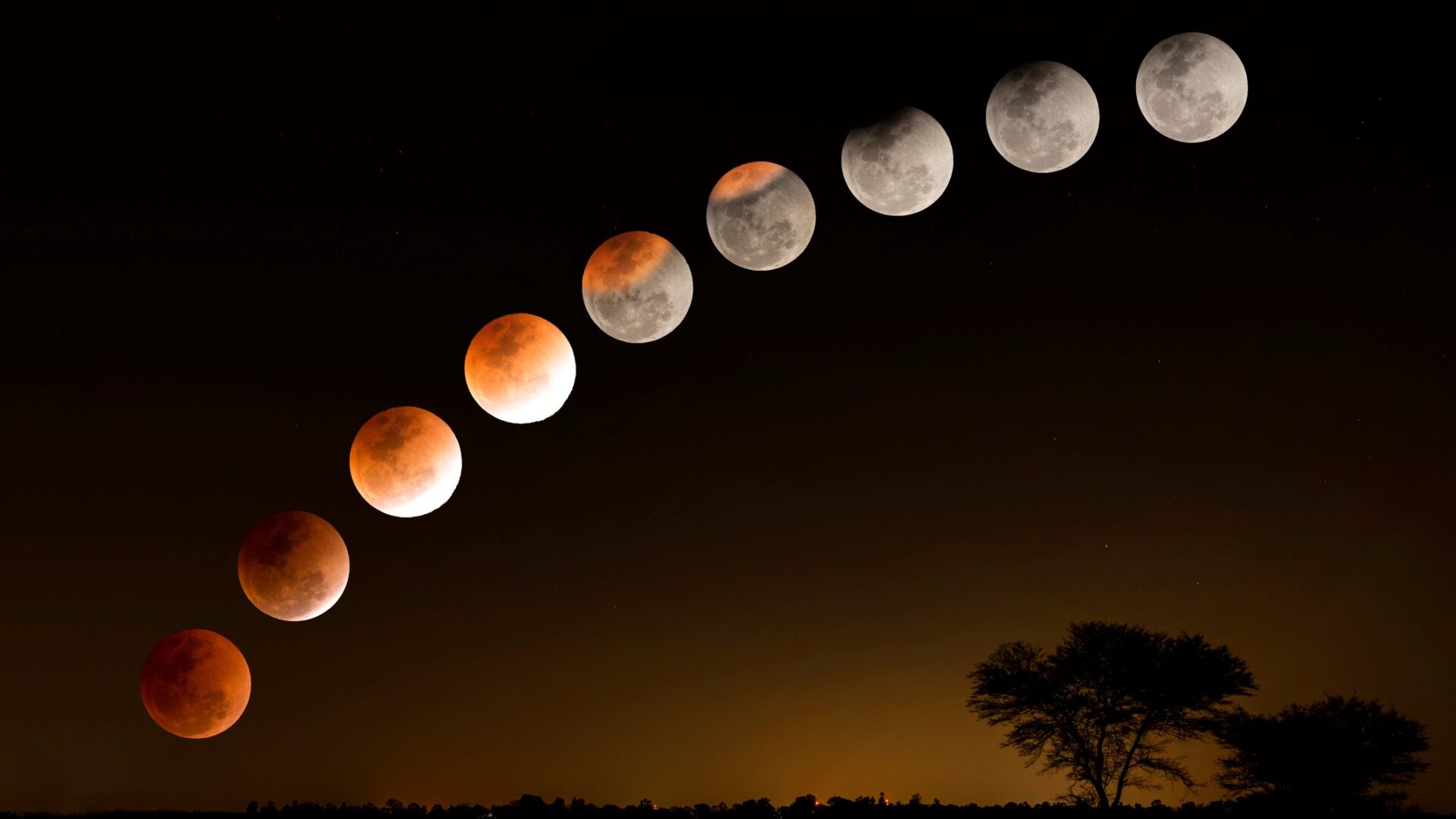
A deep partial lunar eclipse will be visible across Switzerland early on Friday, 28 August 2026. At its peak, about 93% of the Moon will be covered by Earth’s darkest shadow, creating an “almost total” eclipse without the Moon disappearing completely.
In Zürich, the penumbral phase will begin at 3:23 AM CEST. The visibly darker partial phase will start at 4:33 AM, reach its maximum at 6:12 AM, and end at 6:46 AM. The precise end time varies slightly across Switzerland; in Neuchâtel, for example, the partial phase is expected to end at 6:54 AM.
The Moon will be low in the western-southwestern sky at maximum eclipse. In Neuchâtel, it will stand only about 5.8 degrees above the horizon at 6:12 AM, making an unobstructed view essential. The Moon will set shortly afterwards, at about 6:54 AM in that location.
The faint penumbral shading will continue after moonset, with the entire eclipse ending at approximately 9:01 AM CEST according to the broader Swiss timetable. That final phase will not be visible from locations where the Moon has already fallen below the horizon.
Here’s a quick weather update for this week.
Read More: Switzerland’s Individual Taxation Reform: Timeline Set 2032
Lunar Eclipse To Appear Over Switzerland: Best Places To Watch
No special eye protection is required for a lunar eclipse, unlike a solar eclipse.
Swiss observers should choose a location with a clear view toward the west-southwest. Hills, buildings, trees and mountain ridges could block the Moon, particularly around maximum eclipse when it will be only a few degrees above the horizon in some parts of the country.
Useful preparations include:
-
Check the local Moon-set time, since it varies by location.
-
Arrive before 4:33 a.m. to see the partial phase begin.
-
Select an elevated site with an unobstructed western horizon.
-
Use binoculars or a telescope only if convenient; the eclipse is safe to view with the naked eye.
-
Check the weather forecast shortly before the event.
Small Portion Of Moon Will Remain Outside Earth’s Umbral Shadow
The event is classified as a partial lunar eclipse because a small portion of the Moon will remain outside Earth’s umbral shadow. Nevertheless, the eclipse will be unusually deep: about 93% of the lunar disc will be immersed in the umbra at maximum.
The shadowed portion may take on a dark red or orange tint. This colour is produced when sunlight passes through Earth’s atmosphere before reaching the Moon; the atmosphere scatters much of the blue light while allowing more red light to continue along the curved edge of Earth.
Because the Moon will not be fully immersed in the umbra, the event will not technically be a total “blood moon.” However, its appearance may closely resemble one during the deepest phase.
The August 27–28 eclipse will be visible from broad parts of the Americas, Europe, Africa and other regions, although the timing and viewing conditions will differ by location. In Switzerland, the most dramatic period will occur just before sunrise, when the Moon is descending toward the western horizon.
For Swiss skywatchers, the event will therefore depend less on special equipment than on clear weather and a completely unobstructed horizon. Those who find a suitable viewing location may see the full Moon darken dramatically before it sets on the morning of August 28.